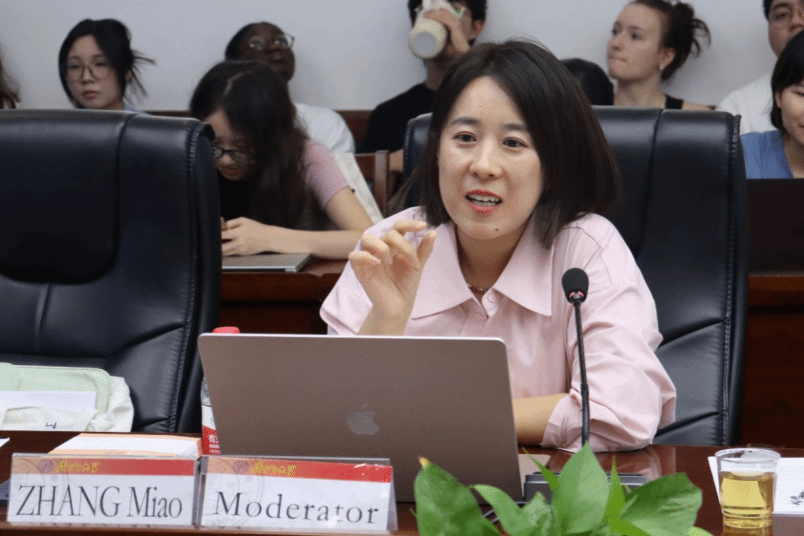
(Dr. Zhang Miao hosted this academic lecture)
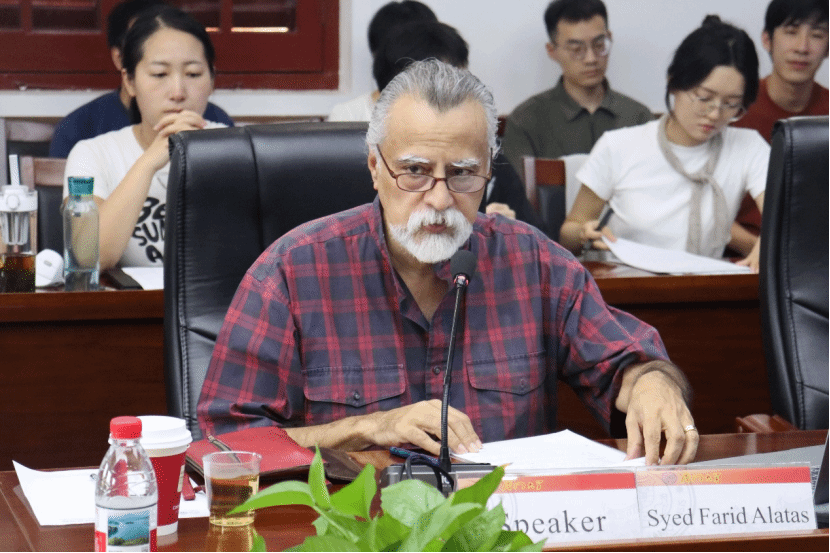
(Professor Syed Farid Alatas gave a lecture)

(The discussant Dr. Shi Yuning made a speech)

(The discussant Dr. Wang Zhaohui made a speech)
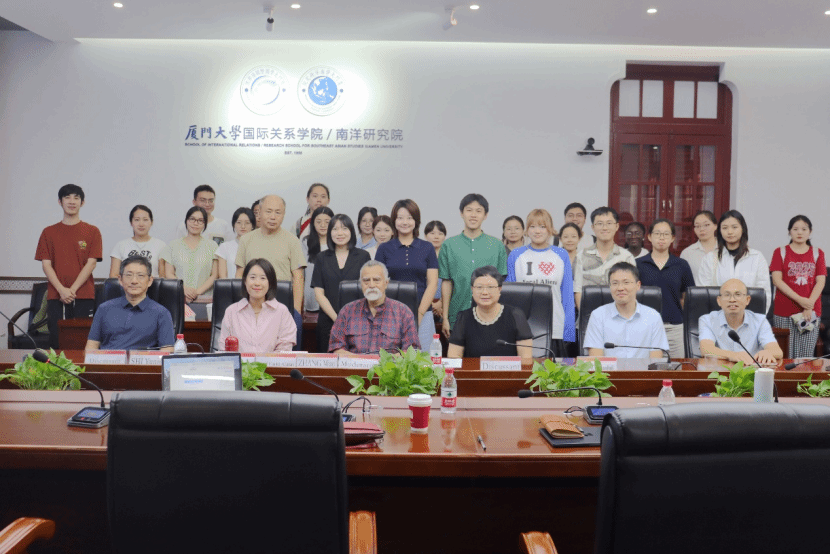
(Group photo of the attendees)
On the afternoon of September 17, 2025, The 81st Session of the Lecture Series of Southeast Asian Affairs and Global Perspective was held in Meeting Room 301-3, Nan’an Building, Xiamen University. Professor Syed Farid Alatas was invited as the keynote speaker, and the theme of the lecture was The Significance and Diversity of Decolonization Thought in Southeast Asia.
Host Dr. Zhang Miao extended a warm welcome to Professor Alatas, and briefed the attending faculty, students and guests on his academic background, core research interests and major research outputs.
In the lecture, Professor Alatas first sorted out the historical evolution of decolonization thought. Professor Alatas emphasized that colonial legacies have left a profound impact on the academic level; academic research in the non-Western world is often forced to accept existing theoretical paradigms, lacking the space to put forward questions and concepts based on its own experiences. This academic "dependency" is deeply rooted not only in institutional and resource aspects, but also in psychology and ways of thinking. This situation has long suppressed or marginalized local experiences and indigenous concepts, making it difficult for them to enter mainstream academic discourse.
Then, beyond criticism, he further pointed out the constructive dimension of decolonization. Decolonization is the reconstruction and innovation of knowledge systems and intellectual traditions, which means local scholars should explore theoretical elements that can engage in dialog with modern social sciences from local historical and cultural resources, so as to promote the development of independent knowledge traditions. This process does not entail an outright rejection of Western theories, but rather involves their critical selection, adaptation, and integration to address issues within local societies. From this perspective, the goal of social sciences is no longer the passive transplantation of existing concepts, but the development of theoretical frameworks that are both critical and able to explain realities, thus embodying both universal significance and local concerns.
Finally, combining the specific experiences of the Malay world, he demonstrated the diversity of decolonization thought. These attempts have demonstrated the diversity of decolonization thought: it includes both profound criticism of academic dependency and active pursuit of intellectual autonomy. Through such cases, Professor Alatas pointed out that Southeast Asia is not only a recipient of colonial experiences, but also an important source of theoretical innovation and knowledge reconstruction.
During the lecture exchange session, the discussants Dr. Wang Zhaohui and Dr. Shi Yuning successively shared their insights and original views gained from the lecture. The Q&A session was highly interactive, with teachers and students at the venue raising their hands to ask questions enthusiastically. Professor Alatas gave detailed answers to each question one by one, creating a strong atmosphere of on-site communication. On behalf of the school, Dr. Zhang Miao extended sincere gratitude to Professor Alatas. The lecture concluded successfully to warm applause from the entire audience.
